Index
Home
About
Blog
Date: Tue Oct 26 13:42:29 1993
From: mikef@rosevax.rosemount.com (Michael Foerster)
Subject: Re: High Idle RPM for short periods
To: z-car@uunet.UU.NET@dixie.com

> So does anyone have any ideas as to what the emission controls would be
> attempting to do by keeping the idle speed high for a few seconds after
> coming to rest?  Clearing the plugs?  Running lean to heat up the cat?
> Screwing with the owner's mind?

	I know that my 78 has a spring loaded dashpot that does the same
	thing.  When you press the throttle, the pod is filled with air.
	When you let off, it holds the thottle open for a few seconds
	so the throttle doesn't slam shut.

	You should be able to adjust it.

	Mikef

[Modern engines have an Idle Air Control stepper that controls the engine
idle under closed loop control of the ECU by bypassing air around the
throttle.  There is no dashpot.  Comparisons with previous years is
worthless because emission requirements, vehicle weight and a myrid of
other things change.  If it took a momentary high idle to pass emissions,
that would be incorporated.

I don't know if the 93 has high idle built in but I do know one thing.
If the IAC is working then the high idle is being controlled by the ECU.
The IAC is pretty easy to diagnoise.  In fact, the ECU should drop an
error code.  But if the thing is working, one can hear the stepper motor
stepping.  An automotive stethescope might be necessary.  This thing is
responsive to such things as turning the lights on or turning the
steering wheel, activating the power steering so it is easy to make
operate at idle.  JGD]
Date: Thu Mar 3 04:01:14 1994
Subject: Idle air Control
X-Sequence: 3880
From: John De Armond

This applies to any car that uses Bosch L-jetronic injection systems
or otherwise use the thermal idle air control valve.  This valve
supplies extra air to the engine when it is cold.  It consists of a
vane valve operated by a bimetal coil that is heated by both
a 12 volt heater coil and by the engine compartment heat.

My 635 started not idling well when cold.  An examination of the IAC
showed the vane closed even when cold.  The book recommendation is,
of course, to replace the thing, an expensive proposition.  A little
known fact is that this valve can be re-calibrated.

I first cleaned the thing using aerosol carburator cleaner to make
the vane was not sticking.  The calibration adjustment is the
little lock-nutted stud that protrudes from the vane chamber
next to the heater tube.  When the lock-nut is loosened, the stud
slides in a small groove.  This sliding motion operates a cam that
changes the vane position.

The calibration consists simply of loosening the nut a little, prying
the stud sideways until the vane opens a quarter of an inch or so
at room temperature and retightening the nut.

Checkout consists of putting the thing in the freezer to make sure it
opens almost all the way and then applying 12 volts to the heater to make
sure it closes fully.

Final calibration involves checking the idle RPM cold vs hot.  The engine
should idle at about the same speed.  If not, the stud can be moved
a bit either way.

This little adjustment saves the ~$100 this valve costs.

John
From: John De Armond
Newsgroups: rec.outdoors.rv-travel
Subject: Re: Brake abuse - was Brakes Fading
Message-ID: <qm2vgu8lfkhrfik9c0l3kglfpkgj5c82u2@4ax.com>
Date: Tue, 18 Jun 2002 15:32:49 -0400

On Tue, 18 Jun 2002 03:05:35 -0400, bill horne <reddog@rye.net> wrote:

>Will Sill wrote:

>My 96 does the same thing. Always has. It appears to be designed to do
>that, and it annoys the hell out of me, too. When I go to the mountains,
>I disconnect the Throttle Position Sensor (TPS). This gives me immediate
>engine braking when I let off the throttle. It also gives me a slightly
>rough idle, but I can live with that in exchange for engine braking
>while in the mountains.

If you pull the Idle Air Control solenoid lead instead, you won't have any of
those problems, you won't lose acceleration enrichment and you won't come
nearly as likely of setting a code.  If you carry a second solenoid (junkyard
for pennies) and plug it in to the connector, then the computer will remain
more or less happy.  At least until it runs the part of the OBD-II sequence
where it tests the IAC and sees it's not responding.

Your ECU has probably been hacked (I'd know from the last for digits of the
part number) and if so, that behavior can be modified.

John
From: John De Armond
Newsgroups: rec.outdoors.rv-travel
Subject: Re: Engine braking - was - Re: Brake abuse - was Brakes Fading
Message-ID: <7n03huoe3l2vqi0jltb9ttfdqa3jsemqh8@4ax.com>
Date: Thu, 20 Jun 2002 03:47:45 -0400

On Thu, 20 Jun 2002 01:13:54 -0400, bill horne <reddog@rye.net> wrote:

>"Sandy A. Nicolaysen" wrote:
>
>> As I've stated in another thread, Bill Horne has a legitimate gripe
>> about the lack of engine braking caused by delayed throttle closing.
>> As far as emissions issues are concerned, we've managed to make it
>> from 1974 to 1980 without computerized controls and mandated catalytic
>> converters.  IMO early throttle closure will not cook the cat.
>>
>> Maybe if Bill would post what year/make truck he has I could give some
>> more insight to this.
>>
>> Regards, - Sandy
>
>96 Chevy PU, 5.7L Vortec. I could be wrong, but I don't think it has
>anything to do with a delayed throttle closing. I think the throttle is
>closing when I let off the gas. The TPS tells the computer something,
>and about 5 seconds later, the computer tells the transmission
>something. I think this for two reasons:
>
>1. I don't see any device on the throttle body or accelerator cabling
>that could hold the throttle off idle.

That is correct.  Idle control is done by a totally separate device called the
Idle Air Control valve.  This is a stepper motor-operated valve that bypasses
air around the throttle plate.  The ECU uses this motor to control the idle
speed, to improve mileage and several other things including emissions and NVH
reductions.

Under the theory that a picture is worth a thousand words, here is a photo of
the throttle body from a Vortec engine:
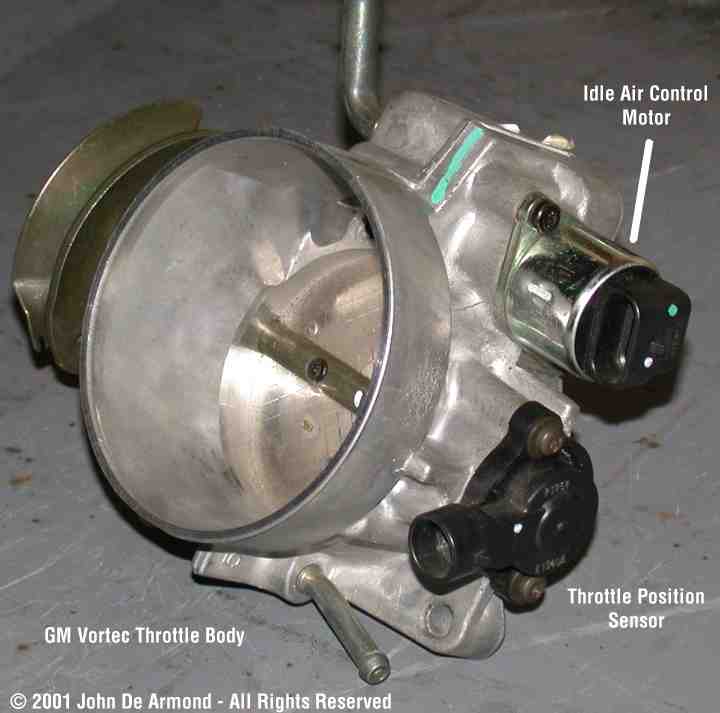
This is one of two such throttle bodies that I'm using on a twin turbo LS1
engine I'm currently working on.  The IAC motor is identified in the photo.
There is a weatherpack-style connector containing 4 pins that plugs into that
motor.  If you disconnect this connector, you disable the IAC function.

You'll also eventually cause the computer to set a code.  If you get a spare
IAC motor from the junkyard or whatever and plug IT into the connector instead
of leaving it dangling, you will make the ECU much happier.  It still will
evetually set a code when the OBD-II IAC test fails but that takes time.

If you want to switch this unit off, you'll need a DPST switch.  There are two
pairs of wires; you'll need to break one of each pair.  The stepper motor
remains in the last place it was driven so it is a good idea to flip the
switch at idle.  That is, if you want a normal idle.

Taking out the IAC is MUCH more satisfactory than the TPS.  The TPS is used
for a wide variety of functions and is vital for smooth engine operation.

>
>2. If I simultaneously let off the gas and downshift, engine braking is
>immediate. More on this: (Assume I'm now in second gear)
>If I touch the gas pedal, engine braking is gone for about 5 seconds.
>However, if I shift to third and back to second, engine braking occurs
>as soon as I shift back to second, even if the 5 seconds has not
>elapsed.
>
>A similar thing happens in third. If I let off the gas and shift from OD
>to third, engine braking is immediate. If I touch the gas, the ole 5-sec
>delay once again appears.
>
>Same in first, or going from second to first.

All this is normal.

John
From: John De Armond
Newsgroups: rec.outdoors.rv-travel
Subject: Re: Engine braking - was - Re: Brake abuse - was Brakes Fading
Message-ID: <fin5hu8icep7soblh520iecgqc88oa2ng1@4ax.com>
Date: Fri, 21 Jun 2002 04:07:12 -0400

On Thu, 20 Jun 2002 05:23:11 -0400, bill horne <reddog@rye.net> wrote:

<massive useless quotes deleted.

>
>Ok, but when I disconnected the IAC (with engine off), and then ran down
>the road, why didn't it eliminate the delay?

Probably because the stepper remained where it was when you turned the engine
off.  Try unhooking it while idling normal.

John
From: John De Armond
Newsgroups: rec.outdoors.rv-travel
Subject: Re: Brake abuse - was Brakes Fading
Message-ID: <cve2iuk9rfitap2m7i8q8kv0fi54iaiol2@4ax.com>
Date: Tue, 02 Jul 2002 01:42:25 -0400

On Tue, 02 Jul 2002 00:08:08 -0400, bill horne <reddog@rye.net> wrote:


>Well, I thought I had a handle on this thing after Neon's input, but
>something doesn't fit.
>
>Here's what I know:
>Disconnecting the TPS eliminates the delay, but causes other minor
>problems.
>Disconnecting the IAC when idling in gear, eliminates the delay.
>
>Here's what I think I know:
>There is no device other than the throttle cable to control the throttle
>valve.
>
>But now I'm told that the throttle is kept cracked open. What device
>keeps the throttle cracked open, and where is it located?

The IAC is what does this.  Remember that it is a small throttle valve that
operates in parallel with the main one.  This valve flows enough to run the
engine up at least a couple thousand RPM in neutral.  The computer  has total
control of it so that the computer  can "open the throttle" whenever its
program tells it to.

Now when we move up to throttle-by-wire like the 'Vette uses, things change.
The gas pedal operates a series of pots (for redundancy) that merely send your
request to the computer.  If it likes what you asked for it commands a servo
to open the main throttle.  It also uses this same throttle, servo and high
res TPS to control idle and all the other stuff that the IAC does on your
truck.  I have one of these servo throttles here in my shop.  Amazing how fast
it can snap the throttle open.

John
From: John De Armond
Newsgroups: rec.outdoors.rv-travel
Subject: Re: Brake abuse - was Brakes Fading
Message-ID: <g234iug3gl24g2c2fmihjgbsaau2o0on86@4ax.com>
Date: Tue, 02 Jul 2002 16:37:18 -0400

On Tue, 02 Jul 2002 02:12:20 -0400, bill horne <reddog@rye.net> wrote:

>> The IAC is what does this.  Remember that it is a small throttle valve that
>> operates in parallel with the main one.  This valve flows enough to run the
>> engine up at least a couple thousand RPM in neutral.  The computer  has total
>> control of it so that the computer  can "open the throttle" whenever its
>> program tells it to.
>
>> John
>
>Ok, that makes sense. My mental hangup was that when I think 'throttle',
>I 'see' a butterfly in a hole. It never occurred to me that the IAC -
>which isn't a butterfly in a hole - would control a really significant
>amount of air flow.
>
>Again, what are the cons - short and long term - of disabling the IAC
>either permanently, or with a switch just for mountain driving - which
>is where the delay really annoys the hell out of me?

I hack older computers so I'm not all that familiar with the OBD-II stuff so I
may be on thin ice here :-)

I know for sure that it will eventually set the OBD-II code for failed IAC.
This will turn your "check engine" light on.  So many things turn that damned
light on with OBD-II that a lot of people just let the light stay on and
ignore it or tape it over.  The problem is, the light then isn't available for
REAL problems.  If you only keep it off a short period of time, the code will
probably reset itself, though it will log a historical failure.  That showing
up on a subsequent dump might prompt an ignorant or unscrupulous mechanic to
try to sell you a new IAC motor.

Remember that the stepper motor stays where it was last actively driven by the
computer so what effect it has on driveability depends on when you disable it.
If you have a good stable idle with a warmed up engine when you flip it off,
then there will be little/no effect over the short term.

Fuzzy memory here, but the ECU drives the motor to "home" (can't recall if
that's fully shut or fully open on late model vehicles), I think, on engine
stop.  In any event, if you disconnect the IAC with the engine off, the
results probably won't be satisfactory.  Either the engine won't idle or it'll
idle very fast.

I know that the late model ECU has been hacked.  I've seen mail about it on
the mailing list but I didn't pay attention.  I might could find a name or
address if you'd be interested possibly having that hacked out and would be
willing to pay said person.  If you're interested in this,drop me a note with
the truck model and VIN (drop the last few digits for privacy) and I'll ask
around.

John
From: John De Armond
Newsgroups: rec.outdoors.rv-travel
Subject: Re: Brake abuse - was Brakes Fading
Message-ID: <4ch4iu0i807e97rvr7k4rcco93th46gdif@4ax.com>
Date: Tue, 02 Jul 2002 20:55:31 -0400

On Tue, 02 Jul 2002 17:25:58 -0400, bill horne <reddog@rye.net> wrote:

>Neon John wrote:

>Ok, I have my own OBD II reader which claims to also erase the DTC in
>the computer if I tell it to do so. And I'm congenitally wired to
>initially disbelieve any mechanic that tells me anything that will cost
>me money.

 :-)  Yes, that command does indeed clear the memory - at least all the memory
the General wants us to get at.  I use a laptop-based scantool for the little
bit of OBD-II stuff that I do.  I can see everything clear after I issue that
command.

>
>> Remember that the stepper motor stays where it was last actively driven by the
>> computer so what effect it has on driveability depends on when you disable it.
>> If you have a good stable idle with a warmed up engine when you flip it off,
>> then there will be little/no effect over the short term.
>
>Long term? Assume an IAC that was turned off while idling in gear with a
>warmed up engine.

Oh, probably nothing that matters.  I suppose it could overheat the cat.
Could cause you to flood the engine by trying to manually duplicate the IAC's
start function.  That could shorten engine life by washing the cylinders, etc.

>
>> Fuzzy memory here, but the ECU drives the motor to "home" (can't recall if
>> that's fully shut or fully open on late model vehicles), I think, on engine
>> stop.  In any event, if you disconnect the IAC with the engine off, the
>> results probably won't be satisfactory.
>
>You're right, they weren't - idle was way too high.

OK, that kick-starts my memory.  I thought the IAC was driven full open to
"home" but I wasn't sure.  Everything the computer does is in terms of "steps
from home" so it has to home the stepper to know where it is, as there is no
position feedback.

>
>Which prompts another question - which I'll get to after: I've learned
>that this trucklet doesn't require that I touch the pedal to start it.
>When I disconnected the IAC (idling in gear), the thing didn't start
>with its usual ease the next day.
>
>Could this likely be because the disconnected IAC is now closed, and the
>starting problem could be overcome by just cracking the real throttle
>with the pedal when cranking?

During the EPA smog driving cycle (which bears only a distant resemblance to
actual driving) the entire discharge from the exhaust is captured in a big bag
and then sampled (modern techniques may do composite sampling but the effect
is the same.)  Thus all emissions accumulate.  Since starting contributes
probably 95% of the total emissions a modern vehicle emits during an average
trip, the start sequence is vitally important to the overall emission control
strategy.  Therefore the computer attempts to take total control of the start
and immediate post start period.  It presets the IAC and the injector pulse
width such that the engine will start as quickly as possible.  The literature
is now talking about the reducing the number of individual cylinder cycles
before start.  Once started, the computer optimizes the engine for cat fast
light off.  Of course, if you try to mash the gas while starting, you screw up
this strategy but since the EPA cycle doesn't include a disobedient user,
that's no matter :-)

The problem you'll probably have is that since the computer tries to set the
mixture exactly right to be clean at initial start, you're unlikely to nail
the mix correctly by manually pressing the accelerator.  The engine will
eventually start - as you've found - but you'll be back to the same situation
you had with carbureted engines - cylinder washdown from rich start, cat
overheating (I know you don't care but it can present a fire hazard, not to
mention poor performance if the cat melts.) and such.

if it was my vehicle and I didn't want a hack, I'd mount a switch in the
cockpit so that I could turn the IAC off and on.  I'd leave it on except for
mountainous driving.

BTW, you'll probably see a decrease in mileage with the IAC off.  In addition
to venting the cat, the IAC opens on rundown to reduce pumping losses.  That's
the coasting you feel.  You don't like it because it's different but it does
save a bit of fuel.  And for the General, it adds a significant amount to his
CAFE which is what that is REALLY all about.

Everyone ought to keep that in mind when they (with absolutely NO actual
knowledge) declare that Deeetroit ought to be forced to build higher mileage
vehicles.  They can do it but most people probably won't like the driveability
results.

I have a friend who's a firmware engineer with Ford.  He's been working in
their CVT (continuously variable transmission) division for a decade or more.
He told me quite some time ago that they have a CVT design tested and ready to
go.  It would get much better mileage, better acceleration and would be much
smoother than a conventional AT.  But every time they test it with people, the
people don't like it and of course Ford is way too 'fraidy cat to innovate and
educate.

Ideally programmed, the engine ramps up rapidly to its most efficient
operating point (normally torque peak) and stays there while the CVT varies
the ratio as the vehicle accelerates.  And it totally freewheels on decel.  Of
course, they can program it do simulate almost any behavior, including that of
a conventional AT but then all the benefits go out the door.

John, off on a trip for a few days
Index
Home
About
Blog