Index
Home
About
Blog
From: John De Armond
Subject: Re: waterheater A.C. modification on my 5th wheel
Date: Thu, 23 Sep 1999 18:39:29 EDT
Newsgroups: rec.outdoors.rv-travel

GBinNC wrote:
, or if I want to keep it hot it won't use so
> much propane, since it's already hot. (Sure wish I had an "Aqua-Hot"
> type deal...)
>

If you mean an on-demand water heater, Paloma (japan) makes an
on-demand propane heater small enough for an RV.  Designed for
marine use but perfectly suitable for RVs.  I have used their larger
models in my home and my restaurant for over 10 years and love 'em!
Imagine having continuous hot water regardless of how long you
imitate a whale in the tub!  These are different than most on-demand
heaters in that they contain a proportioning valve that meters the
gas in accordance with the water flow.  Thus you don't get varying
temperature with varying water flow like you do with the instant-on
ones that are only on-off.  Cost for the RV-sized one should be
about $300.  Physically, the device is about the size of a toaster
oven.

The importer is in Dunlap, TN.  A hardware store nearby, one of
their largest dealers and where I get mine is Valley Hardware, 423
949 4959,
BOX 1213
225 RANKIN AVE, S
Dunlap, TN 37327
Marsha Summers is the owner.

John
From: John De Armond
Subject: Re: waterheater A.C. modification on my 5th wheel
Date: Thu, 23 Sep 1999 23:31:09 EDT
Newsgroups: rec.outdoors.rv-travel

"Light, Ed" wrote:
>
> Aqua Star has been bought by a German giant -- I've forgotten their name --
> with the result that their tankless heaters, both propane and natural gas,
> are pilotless and have a higher heat rise than before.
>
> It's the other brand besides Paloma, and does make a little one.
>
> Beware letting a tankless freeze with water in it. It may expand and break.
> You can have water flowing through it to prevent this.

Fergot to mention that :-)  Paloma makes a freeze kit for their
units.  Consists of some baffles and an electric heating blanket
that wraps around the gas metering valve.  The pilot keeps the heat
exchanger from freezing, at least on the mountains here in the South
where things rarely get below zero.  The unit in our cabin is so
equipped (after we learned how cold it gets in the laundry room the
hard way! That one cost us a control valve) and has been stone-cold
reliable.  The heating blanket only draws a few watts and so could
be powered from a small inverter when not on shore power.  yeah, I
know, sounds like a lot of trouble.  But never running out of hot
water is worth it.

John
From: John De Armond
Subject: Re: Instant hotwater from 110v
Date: Wed, 05 Jan 2000 15:05:17 EST
Newsgroups: alt.rv.pop-up-trailers,rec.outdoors.camping,rec.outdoors.rv-travel

Allen Malone wrote:

> Can you give a pointer where the specifications for the Paloma Marine / RV
> models can be found?
>
> The only information that I have found on the web is for models that
> specifically state that they are not for use in Recreational Vehicles,
> Mobile Homes, Boats and other Watercrafts.

I can't seem to lay my hands on my brochures but the dealer (and
importer) that I deal with is

Valley Plumbing & Electric
BOX 1213
225 RANKIN AVE, S
Dunlap, TN 37327

Marsha Summers is the owner.  They stock the full line plus repair
parts.  really nice folks and they ship anywhere.

I've never searched the net for Paloma but the way I originally
became aware of them was from an employee who lived on a house
boat.  His boat had a Paloma marine heater.  It appeared to install
the same way as an RV heater.

While on the subject, I took a look at the Precision Temp on-demand
heater (thanks  Chris for the pointer).  Looks to be a nifty unit
but I still give the nod to the Paloma unit.  Both perform the same
function, that is, heat a variable rate of water flow to a set
temperature.  The difference is the Precision unit uses a flowmeter,
microprocessor and proportional gas flow valve while the Paloma unit
uses a really nifty integrated flowmeter/gas valve that does the
same thing without the electronics.  While not being one of the
anti-electronics neo-luddites, I DO look to avoid unnecessary
electronics on the RV where the electrical and physical environment
is rather hostile.  There are only two moving parts to the Paloma
valve - a valve stem and a neoprene diaphragm.  My oldest heater is
10 years old.  I brought it with me when I moved from Atlanta about
5 years ago.  I replaced the first diaphragm last year.  It was
thoroughly eaten up.  I replaced the second diaphragm this year.
Again, eaten up.  Our utility pours so much chlorine in our water
that little green clouds rise up out of the bath water (ok, not
really but still a LOT of chlorine).  The point being, with decent
water, the Paloma is trouble free for years.  I have another unit at
my second house in the mountains that is also 10 years old.  With
mountain well water, the unit is like new.  I have another in the
restaurant.  It experiences the same bad water as we do and has the
same diaphragm life problem.  Finally, my parents have one in their
house.  With decent water, it has worked for over 10 years without
any problems.

The other difference is that the Precision unit is significantly
more expensive.  Those electronics cost money.  No hard data on the
cost of the Paloma unit but the much larger units I use here cost
about $500.  Since the marine unit is smaller and simpler, it should
be a fraction of that price.

The only caveat I offer for these units is that poor water quality
will have a much more rapid negative effect on them than on tank
heaters.  The heat flux across the heat exchanger tubing is much
higher and the walls are thinner than the walls of a tank.  On this
really lousy water we have here, I've had to patch a couple of
pinholes in the heat exchanger.  Luckily both were outside the tube
sheet so they could easily be soldered.

The other consideration for use on RVs for all these tankless
heaters is the RATE of gas usage.  While these things use less total
propane than tanked heaters because there is no standby heat loss,
their DEMAND while operating is large.  This can cause your propane
tank to ice up and lose pressure, particularly in cold weather
and/or when the tank is almost empty.  Worst case, the pressure
might drop enough to cause other appliances to quit working for
awhile.  This is, of course, manageable.  Use in moderation, use
when the tanks are warm, swapping over to the alternate tank (when
available), even draping warm towels over the tanks are all
solutions.  This is an edge-of-the-envelope type of fairly rare
problem but it's nice to be aware of it. Nothing worse than to have
been out winter camping, having been freezing your tush off,
anticipating a nice long hot shower and having the hot water peter
out.  Of course, you might have had to run 100 gallons of water to
cause this so in comparison to the typically 6 gallon capacity of
tank heaters, this really isn't such a bad tradeoff.
From: John De Armond
Newsgroups: sci.engr.heat-vent-ac
Subject: Re: Choices for hot water
Date: Sat, 10 Feb 2001 05:33:32 -0500

Scot Desort wrote:

> I've also looked at the instant hot-water units, also fired by propane. They
> obviously take up very little space, and can be power vented. Does anyone
> have any experience with them, good or bad? If I locate it in the closet,
> are there any national codes that restrict what can be stored in the closet?
> With the electric unit, since there is no combustion, there isn't much for
> me to worry about when I store things in the closet.

For the last approx 15 years I've been using the Paloma brand of
instant water heater in my house, my cabin, my restaurant and my
rental properties.  As far as I'm concerned, this is the only way to
heat water.  Hotwater is available in seconds in unlimited quantity
and when you're not heating water, you're not expending energy
maintaining a tank of water.  About the only negative is that if
your water is hyper-chlorinated, a neoprene diaphragm in the gas
regulator corrodes up and fails every couple of years.  There is
rumor of a teflon coated diaphragm for such conditions but I have
not yet obtained one.

The yellow efficiency sticker rates these units on the low end
because the government testing is cooked for tank heaters.  My
actual operating experience is that this heater uses a fraction of
the fuel used by tank heaters with similar water usage.  I keep a
tank heater equipped with flex hoses and quick couples in the
warehouse for in the event the restaurant heater goes down
(diaphragm failure.)  I can connect this heater in seconds so that
the restaurant continues to operate while I repair the Paloma.
Using daily gas meter readings, I've learned that the tank heater
consumes about a third to half again as much gas as the Paloma.

There is a huge intangible with the Paloma.  That is the complete
lack of worry of running out of hot water.  If you've had a bad day
and need to take one of those 45 minute steamy showers with a high
flow shower head, you can do so.  Want to fill a 200 gallon hot
tub?  No problem.  If you want to wash your car in cold weather
using warm water, you can.  At the restaurant, I hook a cold water
pressure washer to hot water and get hot, high pressure cleaning
without having to buy or deal with a hot water pressure washer.

We use the PH-24 in the restaurant and house.  We use the PH-12 in
the cabin and rental properties.  The PH-12 is adequate for normal
household use until the water gets near freezing in the winter.
Then the flow becomes marginal.

A major benefit of the Paloma is that even the PH-24 can be tucked
under the arm and carried about.  It is that small.  It simply hangs
on the wall.  Note that if you install the unit in unconditioned
spaces and your area experiences freezing weather, you MUST install
the winterizing anti-freeze kit.  Voice of experience here :-)

There are several other brands of tankless heaters out there but
after looking at all of them at one time or another, I continue to
use the Paloma because:

* size - much smaller than the rest.
* quality - what you'd expect from Japanese mfring.
* proportional control without the need for electricity or (gasp) a
microprocessor!

Proportional control (firing rate is proportional to the water flow)
is vital.  Some tankless heaters are on-off which means you get
scalding water at low flow and tepid water at high flow.  Paloma's
clever mechanical regulator accomplishes what other mfrs pile on
electronics and microprocessors to do.

The japanese Paloma web page is here:

http://www.paloma.co.jp/companye.htm

When I looked there a few minutes ago I was surprised to see that
they had bought Rheem.

Here is an online store that sells Paloma:

http://www.globaltowne.com/globaltownewarehouse/HomeProducts/paloma.htm

I have never done business with this company, as the importer is
located here in Tn and is only about 50 miles away.  But the price
is competitive.  Speaking of price, if you're used to tank heater
prices, gird yourself for some sticker shock.  In the big scope of
things over a 15 or 20 year life, the difference is no big deal but
it IS a significant hunk of change.


> Lastly, placing any type of water heater in a location other than the
> current one would require plumbing work. I don't know how much of a big deal
> it would be to move the hot water supply lines to a new location. The entire
> crawl space and all plumbing is completely accessible.

Well, if you have CPVC or copper plumbing, extending or moving the
heater is pretty simple.  If you have galvanized and it's 20+ years
old, it might be time to start thinking about replumbing anyway if
your water is at all acidic.  The current gas code allows the use of
copper and flex tubing for the propane supply.  High pressure (2 or
5 psi) distribution is now available too, which means you can supply
the 178,000 BTU with soft drawn copper tubing instead of having to
run large diameter black iron.

Drop me a note if you'd like for me to send you a pic of one of my
installations.

John
From: John De Armond
Newsgroups: sci.engr.heat-vent-ac
Subject: Re: Choices for hot water
Date: Sun, 11 Feb 2001 19:45:14 -0500

Tom Beckner wrote:
>
> Neon John <johngdDONTYOUDARE@bellsouth.net> wrote in message
> news:3A8518FC.C3ED95B5@bellsouth.net...
>
> >... High pressure (2 or
> > 5 psi) distribution is now available too, which means you can supply
> > the 178,000 BTU with soft drawn copper tubing instead of having to
> > run large diameter black iron.
>
> Hot showers? I could heat my house, garage and de-ice the sidewalks. Does it
> need an 8" flue?

Ain't it wonderful? :-)  You have to think in different terms when
considering on-demand water heaters.  With no tank to store water,
the burner must be capable of supplying enough heat for whatever
flow rate and temperature rise is desired.  Also remember that the
burner output is proportional to the flow rate.  So while the large
unit will achieve (from memory) a 100 deg rise on 3.5 gallons per
minute, if you only use a half gallon per minute, the firing rate is
correspondingly lower.  But when you need the high, continuous flow,
it's there.  I have 50 gallon sinks in the restaurant.  Nice to be
able to fill 'em in just a few minutes so the hired help can spend
less time standing there watching it :-)

I have indeed de-iced the sidewalks outside my restaurant using hot
water and a garden hose.  I can knock down the bulk of the ice or
snow with hot water and then spread just a little bit of de-ice to
keep it from refreezing.  I can kill all the ice rapidly instead of
just spot removal after many minutes using de-ice alone which
reduces my liability exposure from falling customers.

I have also been known to improvise heat for a tent when working
outside in cold weather by means of a small car radiator lashed to a
squirrel caged blower and hooked to the hot water through a garden
hose.  Water is cheap and plentiful here so the discharge runs to
the gutter.  Pretty slick, especially when working on a vehicle
where combustion heat would be highly unwelcome around fuel.

The heater flue connection has concentric rings for multiple
diameter flue connections.  In the restaurant, I have a short
connection of 6" leading to the old oil burner flue. Elsewhere the
flue diameter depends on the distance to the roof.  I follow their
instructions.  Whenever I can, I locate the heater in the attic so
just a short stub of a flue is necessary.
>
> Seriously, wonder if you could substitute this for a boiler and what is the
> flue configuration?

I would doubt that the regulator/metering valve would withstand hot
water return.  In any event, Paloma says not to.  I'm not sure that
the heat exchanger would survive long term under continuous use.
The heat exchanger looks a lot like an automobile heater core.

John
From: John De Armond
Newsgroups: sci.engr.heat-vent-ac
Subject: Re: Choices for hot water
Date: Fri, 16 Feb 2001 00:54:09 -0500

Scot Desort wrote:
>
> Thanks for the info John.
>
> I was not aware that these units could be installed in unconditioned
> crawlspaces. It makes my choice a little easier as I could have it installed
> near my existing chimney so as not to need to mess with power-venting. It
> would also make running the propane line a lot easier as I would have the
> tank installed near the chimney outside.

[snippity]

> Crawl-space installaltion also solves another problem. If I mount the unit
> near an existing hot-water pipe, I can tie it in right there, pull out the
> old hot water heater in the kitchen closet and cap the lines off. And no
> problem with ventilation requirements.

Ok, now, before you get carried away, remember that this thing
contains water and consumes a lot of air.  It will freeze if exposed
to freezing weather.  I live in the Sunny South where temperatures
in the teens are rare and single digits are almost unheard-of.  If
there is ANY chance of the heater seeing temperatures below 32
degrees, the cold weather kit MUST be fitted.  The first thing that
freezes is the regulator/metering valve.  The diaphragm chamber is
held together with screws with about 5mm thick conical washers under
the heads.  These washers are designed to give so the housing can
freeze without cracking (most of the time).  That's the good part.
The bad part is that when the housing freezes, the housing leaks
around the diaphragm.  Lots!  Nothing worse than to come back from a
trip and see the 2nd story drain from the drip pan under the heater
streaming a huge icicle!  Or to find the ceiling of the floor below
laying on the carpet.  Been there, done that.

The cold weather kit is a heater blanket that wraps around the
regulator.  It will keep the regulator from freezing in the type of
weather we have around here.  The pilot light will generally keep
the heat exchanger from freezing.  HOWEVER!  If you have a power
failure during a winter storm, well, it's freeze-city.

I only caution that you think this through carefully before you
select an installation site.

John
From: John De Armond
Newsgroups: rec.outdoors.rv-travel
Subject: Re: OT - experience with tankless home water heater?
Message-ID: <lgatfus9it9btaujvlmqb5nmh7dm2svre8@4ax.com>
Date: Wed, 05 Jun 2002 20:22:51 -0400

On Wed, 05 Jun 2002 01:38:51 GMT, "Madeleine" <madewarNOSPAM@earthlink.net>
wrote:

>Haven't done it yet, but I'm going to get one of these also.  I live
>alone and there is no way that I need a tank larger than 30 gallons.
>Seems all the really efficient water heaters are 40, 50 or more gallons.
>On demand seems especially suited to me since I travel for so many
>months each year.

Actually what I like the tankless heater for most is when I'm in the mood for
one of those 150 gallon soak/showers.  Any amount of water I want to use is
available.

One of the things you need to be aware of if you get a tankless heater.  That
is, they are very susceptible to freezing.  The heater must either be located
in conditioned spaces or a freeze protection kit fitted.  Even the freeze
protection kit won't protect when it gets VERY cold.  If you leave your house
heatless while you travel, you will have to fully drain the heater.  If it is
installed with the proper valves, this isn't a big deal but it must be planned
for.

Of course, if you live in an area that doesn't freeze, ignore the above :-)

John
From: John De Armond
Newsgroups: rec.outdoors.rv-travel
Subject: Re: OT - experience with tankless home water heater?
Message-ID: <h1btfu88bdtcov1nd3vs6qu9r536u8afau@4ax.com>
Date: Wed, 05 Jun 2002 20:34:38 -0400

On Wed, 05 Jun 2002 04:49:55 GMT, n7ws at arrl net (Wes Stewart) wrote:

>I would go tankless in a heartbeat if I could. Unfortunately, no
>natural gas or propane piping and the electric service to the hot
>water heater is only 30 A.
>
>If I had the wiring capacity I would use one of the SETS models:
>
>http://www.tankless-water-heater.com/products.html

Unless you're into navy-type showers or cold showers, this is way too much
money for way too little performance.  Look at the 220 - 1.5gpm @ 100 deg F
rise.  When the water is coming in just above freezing in the winter time, 140
deg water at that low a flow isn't much.  Even that little bit of performance
costs you fully half your mains capacity on a typical 200 amp service.

In contrast, the unit I use is capable of 5 gpm at 100 deg rise on NG or
propane.  More importantly, I get proportionally more rise at lower flow.  AND
I have a more responsive unit.    My previous unit could do 3.5 gpm at 100 deg
rise.  In the dead of winter when the water was almost freezing, I found that
extremely lacking for showers plus it took forever to fill up the washing
machine.

I'd not consider anything other than a gas unit even if I had to have a tank
installed just for the heater.  If I couldn't install a propane tank, I'd
probably consider moving :-)  I like my tankless heaters that well.

John
From: John De Armond
Newsgroups: rec.outdoors.rv-travel
Subject: Re: OT - experience with tankless home water heater?
Message-ID: <6rh0guctkn4uuuct9gf5u290m1qe35isim@4ax.com>
Date: Fri, 07 Jun 2002 01:46:42 -0400

On Thu, 6 Jun 2002 19:53:28 -0600, "MrFixit" <mrfixitnospam@tcinternet.net>
wrote:

>I have not had the pleasure of removing hard water deposits from a tankless
>yet. The person who was having problems never called back to have it done.
>From what I know you disconnect the inlet and outlet and run muriactic acid
>thru it to remove the scale build up then rinse thoroughly. You do have to
>be careful with doing this because if you leave it in too long or you could
>eat the copper tubes and end up with it looking like swiss cheese.

That's why you don't use hydrochloric acid for deliming.  The proper acid is
phosphoric.  Hell on lime but ignores metals.  And gentle on the skin :-)

>But by the sounds of your usage you probably will not have a problem for the
>life of your water heater.

No lime up problems in eastern PA with a tankless heater and that water is so
hard it rattles coming out the faucet.

John
From: John De Armond
Newsgroups: rec.outdoors.rv-travel
Subject: Re: Tankless water heaters in RV
Message-ID: <4tsjlu88kkd5vt2pk913fg8aob23kj3mfl@4ax.com>
Date: Wed, 14 Aug 2002 02:23:46 -0400

On Sun, 11 Aug 2002 08:28:43 GMT, "Peter Pan"
<PeterPan@NEVERNEVERLANDNOSPAM.sc.rr.com> wrote:

>Maybe I should have been a tad bit clearer. There are actually two on demand
>water heaters, a propane one for boondocking and high use situations (3.2
>GPM max and about $400 bucks), and an electric under sink unit for use when
>in a site (1.5 GPM max for the kitchen/bathroom sinks only <but not for the
>shower> under $180). Consider the under sink unit to be an in site only
>unit, and only active when plugged in and electrical shore or generator
>power is available, otherwise, it's inactive. It uses about 29 Amps when in
>use. If showering in the RV while in site, the propane one has to be used.
>If washing dishes/hands etc while in site, the electric one is used. When
>boondocking, only the propane one is used for all uses. If at an RV park,
>using their showers, only the electric water heaters for the sinks are
>usually used.

I'm a big fan of tankless heaters and own a number of them.  A few thoughts.

I use the electric tankless heaters in the bathrooms and handwashing sinks in
my restaurant so that there will be instant hot water.  These little heaters
draw about 28 amps at >> 240 volts <<.  Even with that considerable electrical
draw the heaters really don't do that good a job in the winter when the
incoming water is cold.  The heater has a cold weather orifice that restricts
flow to a bit under 1 gpm - annoyingly low.  One CAN wash his hands in this
small bit of water but I'd not want to attempt anything more extensive.

In an RV this sort of unit could only be used with 50 amp hookup or from a
large generator.  I would not consider that to be practical unless you spend
all your time in parks with 50 amp service.

For my main source of hot water in my restaurant and attached apartment I have
installed this unit:

http://www.tanklesswaterheaters.com/palomaph24m.html

You'll notice that even with an energy input of 178,000 btu, this heater can
heat just under 3 gpm to a 100 deg rise.  This ranges from adequate in the
winter to great in the summer.  This unit is physically about the size of a 30
gallon drum - much too large for an RV.

Paloma makes several smaller units.  I previously had this model:

http://www.tanklesswaterheaters.com/palomaph12m.html

In the restaurant and currently have one in my cabin and another in my parents
house.  This heater is adequate for residential use if you use a water saver
shower head but cannot supply enough water in the winter for a good high
volume shower.  This unit is a little larger than a 5 gallon gas can - still
too large for an RV.

This unit might work in an RV:

http://www.tanklesswaterheaters.com/palomaph16fs.html

but it does require 120 vac to operate.

Paloma used to make a small unit designed for marine and RV use (I've seen
them on house boats) but I can't find a listing for it anymore.  Judging from
the size of the burner in the ones I've seen vs the units I own, I doubt that
it could supply enough hot water for a comfortable shower in the winter and
would probably push things in summer.

>My understanding is that a replacement Atwood gas water heater with tank is
>about $400, and a hot rodd about $100, so for about $80 more, I can have on
>demand rather than tank based hot water.
>Like I said, I don't know if it will work OK or not (especially in an RV),
>but considering how much I used to spend a year for propane just for heating
>water, it seems like it would pay for itself.
>Oh, the other piece of information, I fulltime in my RV and would love to
>have hot water when needed without heating it 24/7.

I've wanted a tankless solution in my rig since they work so well in my
facilities but so far I have not found a practical solution.

John
From: John De Armond
Newsgroups: rec.outdoors.rv-travel
Subject: Re: Question to Neon John on Tankless water heaters
Message-ID: <s038mu8jdrk7ncgep2imfam3o4k8srbsqe@4ax.com>
Date: Wed, 21 Aug 2002 18:14:33 -0400

On Wed, 21 Aug 2002 13:02:27 -0700, Tom Marik <tom.marik@oracle.com> wrote:

>Dennis,
>
>Gulp!  Seven inch vent!  178,000 BTU per hour!
>
>But even with that, they are talking about one shower head only or dishwasher or
>clothes washer.  It's a lot of hot water but it still requires cooperation.
>Bart Simpson would have a ball with Homer taking a shower.

Not that bad.  I can shower with the washing machine running and never know
the difference.  Remember that you mix cold water in with the hot for your
shower so the flow from the water heater is lower than you'd at first think.
The paloma at full chat can deliver 180 deg water so it takes only a little
hot water to make a shower juuuust right.  The heater has a knob on the front
where you can set the temperature rise you want.

A 7" vent can be used but it isn't necessary.  The flue connection has several
concentric rings for different vent pipe connections.  I used standard 6"
stove pipe on mine because it was handy.  It feeds about 2 feet into an old
coal stove chimney thimble.  The chimney liner is about 6 inches square.  I
can fairly comfortably lay my hand on the flue with the heater at full power.
It is quite efficient.

Since a picture is worth a thousand words, I put a picture up of the PH24m in
my restaurant.
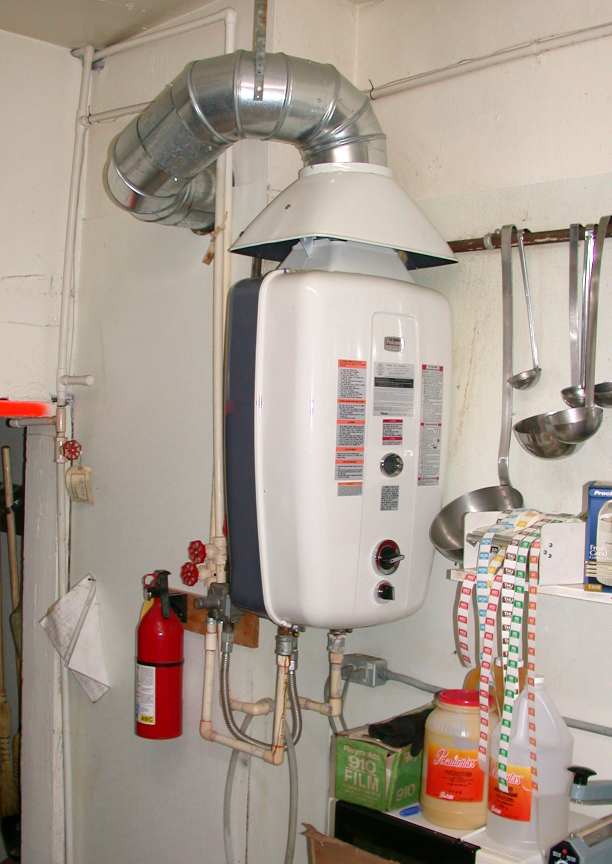
Several things to note.  First, it just hangs on the wall like a cabinet in
otherwise useless space.  No floor space is used.  One can get a size scale of
the unit by the 1 gallon jugs at the bottom of the photo.  If you zoom in on
the flue, you can see the unused 7" attachment ring.  I use high pressure (2
psi) gas distribution in my place. The small regulator under the heater
reduces the pressure to standard natural gas pressure at the point of use.
The top knob turns it on and off and fires the piezo igniter.  The bottom knob
sets the temperature.  The whole front lifts off after removing two thumb
nuts.

John
From: John De Armond
Newsgroups: rec.outdoors.rv-travel
Subject: Re: Instant Water Heater
Date: Wed, 08 Oct 2003 23:57:54 -0400
Message-ID: <l1n9ovg1smlrg6l87qqfh1gd22h7vd5dhf@4ax.com>

On Wed, 08 Oct 2003 12:34:26 GMT, Chris Bryant <bryantrv-06@cfl.rr.com> wrote:

>On Wed, 08 Oct 2003 12:10:12 +0000, Tom Marik wrote:
>
>> << You will notice that almost the entire rest of the world uses tankless
>> water heating that only heats on demand. It is not exotic or odd
>> technology. >>
>>
>> Why are the RV manufacturers so reluctant to install them?
>>
>> Tom M
>
>The only model listed for RV use is the Precision Temp, and it is pretty
>expensive.
>Also- to some extent- RV appliances are built by only a few companies-
>heating appliances by two. RV OEMs will get much better pricing if they
>use all Atwood (water heater furnace and stove) or Suburban (water heater
>furnace and stove).

True.  Plus yet another problem.  Freezing must be managed somehow.  There is
very little thermal mass in a tankless heater and a lot of exposed piping if
the thing is installed outside like a regular RV heater.  That's probably why
Paloma quit making an RV/marine unit.  I have a lot of experience with Paloma
and I can vouch for just how fast one will freeze if exposed.  Their cold
weather kit helps a little but requires shore power.  The only practical
solution is to install the thing in conditioned spaces.  Not terribly
practical in an RV.

John
From: John De Armond
Newsgroups: alt.energy.homepower
Subject: Re: Point of use DHW
Date: Mon, 11 Sep 2006 10:44:04 -0400
Message-ID: <v1sag299m6jspes3aqsvbs0t8iohv70cdu@4ax.com>

On Mon, 11 Sep 2006 06:35:48 GMT, no one that you know
<nooneshome@shaw.ca> wrote:

>Anyone out there using the small 120 VAC point of use hot water tanks or
>the 120 Vac plug in on demand units?
>I was just thinking about getting rid of my big DHW (gas) tank.
>I was thinking one small unit for each bathroom and one under the
>kitchen sink. The problem that is stalling my decsion is the clothes
>washer.
>I am aware that electric is more costly to heat water but me thinks
>(living alone)that on demand small electric in the long run is cheaper
>than heating with gas 24/7/365.
>No I do not want a gas on demand....will not even consider it for now.

I use electric on-demand heaters on my small sinks and a large gas
on-demand for the rest of the place.

Mine are 240 volt, 30 amp units that require dedicated circuits and
breakers.  Still, the performance is marginal, especially in the
winter.  The heater has a restrictor that limits the flow to perhaps a
gallon a minute, necessary to achieve enough temperature rise to call
it "hot".  Actually warm.  In the winter I can wash my hands without
discomfort with only the "hot" water.

This would be totally impractical for a clothes washer.  It simply
can't heat fast enough.  An alternative might be one of those little 5
gallon point of use heaters that fits under a counter.  I've used
those too.  My experience was less than satisfactory.  I put one in
each bathroom of my restaurant and another in a concession trailer.
All three rusted out and started leaking within a year.  The water
here isn't aggressive and 20 year lives are usual for tanked water
heaters.  I had to conclude that it was something with the heaters.
These were purchased from Home Depot.

These little heaters use a relatively considerable amount of power
even when quiescent.  I measured one as part of the power budgeting
for the concession trailer.  If you only use a sink a couple of times
a day then the on-demand heater is MUCH more economical to operate.

I should say in passing that I LOVE my Paloma gas on-demand heater.  5
gpm at 100 deg F rise.  Enough for a luxurious shower even in the
coldest weather when the cold water is near freezing.  I don't know
what you don't like about gas but if you want to get away from a tank
heater, gas is about the only option for anything beyond hand-washing.

John
From: John De Armond
Newsgroups: alt.energy.homepower
Subject: Re: Point of use DHW
Date: Mon, 11 Sep 2006 16:22:07 -0400
Message-ID: <6pgbg2d10d1vv4oo1bvh38665itdddq0b6@4ax.com>

On Mon, 11 Sep 2006 15:42:19 GMT, no one that you know
<nooneshome@shaw.ca> wrote:


>What temp is your guess is your incomming water last time I checked mine
>stays at near 54f all year. They claim these little 110 vac units supply
>1 gpm. Good enough for hot showers. Now I am wondering!

I have city water that comes from the nearby river.  It tracks ambient
by a few days.  The coldest I've seen was 36 deg F.

You can easily do the math to disprove the claim that any heater
operating on 120 volts can impart useful heat to a 1 gpm stream.

At least in my book, 1 gpm isn't suitable for showering at any
temperature.  I term that more a mist than a shower :-)

I've been using on-demand heaters for >20 years.  One common
denominator is that manufacturers lie.  The one exception that I know
of is Paloma which is why I use and recommend that brand.  When you
see a performance claim, do the math before believing it.  As much as
they'd like to, the mfrs can't change physics.

I noticed in another post that the reason you don't like gas is the
service fees.  Agreed.  I was in the same boat.  I solved that problem
by converting to propane.  I bought a used 1000 gallon tank out of the
local free trader for $100 and changed my appliances over to propane.
A couple required an orifice kit but most simply required setting the
orifice to propane and flipping the lid on the regulator to set a
different pressure.  Since you're starting out new you won't have to
fool with that.  You'd simply buy the heater already calibrated for
propane.

 For water heating and perhaps cooking, single fill-up will last over
a year.  I fill up in the summer and let the local companies bid
against each other.

John
From: John De Armond
Newsgroups: alt.energy.homepower
Subject: Re: Electric tankless water heater
Date: Wed, 16 Jan 2008 15:36:35 -0500
Message-ID: <brpso35j0lspq8v0553sa376j8qr6qqab9@4ax.com>

On Wed, 16 Jan 2008 14:51:15 -0500, "Mike Payne" <payne@gru.net> wrote:

>I have a 75 gallon traditional gas water heater.  I don't believe you could
>run it out of hot water if you tried.  It seems to regenerate faster than I
>can ever use it.

You weren't married to my ex :-)

If I didn't have a tankless heater I'd have a gas-fired tank heater.  They do, as a
general rule, recover much faster than electrics.  The disadvantage, at least for the
regular big-box store units without electromechanical baffles is that the standby
losses are significantly larger than electric.  The reason is the flue that runs
through the center of the tank.  When the burner is off, that flue generates a draft
that carries away a significant amount of heat.  Fancier ones have electronic
controls and a damper that shuts down the draft when the burner is off but they're
more expensive.

>
>A con to the tankless water heater is it can only heat water so fast.  Pull
>the water faster than that and it gets colder.

That may be true of some heaters but it isn't of the Paloma.  It contains a rather
fancy hydromechanical control valve that proportionally meters gas according to the
water flow AND limits flow to what it can heat.  With a large enough burner, that
flow is more than you'd normally use.

I used my -2400 Paloma in my restaurant for a decade.  We hand-washed dishes and had
a huge 3 compartment sink that held 60 gallons in each compartment.  The wash and
sanitize water got changed very often.  I'd have needed one of the largest tank
heaters available ($$$$) to keep up with that load.  That Paloma just kept on
truckin'.

The only problem I ever had with the Paloma was concerning the rubber diaphragm in
the control valve.  Cleveland put so much chlorine in the water that it ate the
diaphragm out every few years.  Paloma supposedly has a teflon one for such
conditions but I never got one.  Not a problem now on well water :-)

John
Index
Home
About
Blog