Index
Home
About
Blog
From: John De Armond
Newsgroups: misc.rural
Subject: Re: What's the live expentacy of a deep well pump
Date: Mon, 24 Apr 2006 16:31:04 -0400
Message-ID: <n1dq42t444f2eup8q5nbo6qo4fvfp9nebs@4ax.com>

On Mon, 24 Apr 2006 10:26:21 -0400, "John Gilmer"
<gilmer@crosslink.net> wrote:


>ANYWAY:   just how long to these things last?   Do they just suddenly "go"
>or are there warnings like extra noise or taking longer to fill the tank.

I get about 10 years on a wellpump.  My well is somewhat sandy and the
usual failure mode is the impeller being ground down enough that it no
longer pumps.  I went to a submersible pump the last time around.
Things look much better, as it's been in the well about 15 years and
is still running fine.

As to failure, it depends.  An electrical or mechanical failure is
pretty instantaneous.  OTOH, an abrading-down impeller slowly loses
pumping capacity.  The pump will run longer and may not achieve the
desired pressure.

There can be many other reasons for such symptoms - clogged inlet
screen, leaking down-hole pipe, etc. - so don't expect to necessarily
find a worn-out pump.

I keep a spare pump and a roll of plastic pipe on hand.  I can just
barely extract the pump and pipe by myself with the aid of a homemade
derrick and a small windlass.  If the pump goes out, I can have it out
and replaced in the same day.  So far, all outages causing pump
removal have involved cracks in the plastic pipe.

John
From: John De Armond
Newsgroups: misc.rural
Subject: Re: What's the live expentacy of a deep well pump
Date: Wed, 26 Apr 2006 05:59:45 -0400
Message-ID: <3gdu429lcl1ngn625jc6q0vlovjj7pf87u@4ax.com>

On Mon, 24 Apr 2006 21:31:38 -0400, "John Gilmer"
<gilmer@crosslink.net> wrote:


>First, when I "peeked" by taking the cap off the well head, I sall what
>looked like a 16 gage stainless steel cable going down the opening.   (At
>the top, only the electric wires are accessible; I "suppose" the water exits
>from one of those side adaptors.)

That wire (or rope in many cases) is the emergency retrieval wire.  It
is attached directly to the pump body and is used to hoist out the
pump after the pipe breaks :-(  As it is an emergency device, I'd not
use it for routine hoisting.

>
>Were I to throw caution to the winds, just HOW would I go about pulling the
>mess up?   Would I try the SS wire or find some way of "hooking" the pipe
>when it hooks the adaptor?

It sounds like you have a side exit wellhead.  I have a top exit,
where the pipe, the electrical cable and the emergency retrieval rope
all exit through a cap on the top.  A top-exit pump is easy to
retrieve but I'm not sure how you go about it with a side-exit one.
Probably hold tension on the emergency cable while disconnecting the
pipe at the ninety and then lifting it out.

Here's what the pros use to pull the pump:
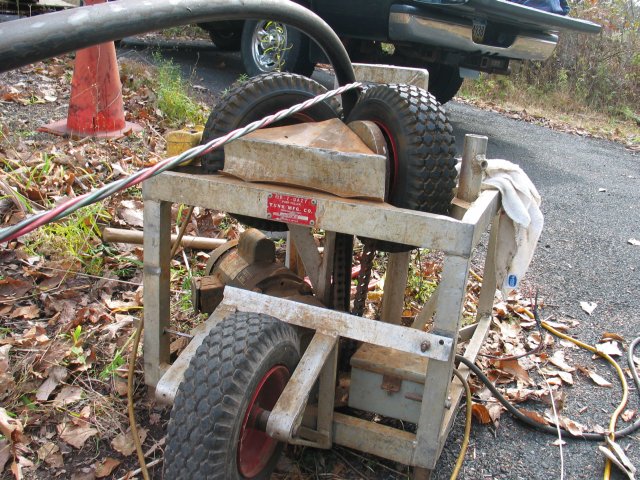
The three wheels on top are pressed against the pipe by spring
pressure.  One of the wheels is chain-driven by the electric motor.

Not having one of those, I rigged up a wooden derrick and
block-and-tackle arrangement.  I lift the roof off the well house and
assemble the ~20 ft tall tripod out of 2X4s sticking up out of the
house.  I hung a block and tackle from the top and had a "chinese
finger trap" affair on the other end to grab the pipe.  This is a
woven stainless steel wire sleeve that fits over the pipe and tightens
around it when put under tension.  Like its namesake.

I got a grip on the pipe with the finger trap, then pulled the rope to
lift up the assembly about 15 ft.  When the block and tackle topped
out, I held the pipe in place with a large wedge of wood driven
between the casing and the pipe and also by dogging off the emergency
rope while I lowered the finger trap for another grip.  I repeated
this process about 15 times and the pump was out.

This is a situation where you pray for a little water leak at the
bottom because the column of water trapped in the pipe weighs more
than the pump!

To do the initial lift so that the pipe under the well cap can be
accessed, I made up a gripper that consisted of the largest vice grips
I could find with a lifting eye welded to the handle.  There is a
steel nipple sticking through the well cap. I removed the external
pipe, grabbed the steel nipple with the vice grips, hooked them to the
block and tackle and gingerly hoisted away.  I was greatly worried
about breaking the nipple, given the weight so I went slowly and
carefully until I had the well cap up high enough that I could hammer
in the wedge.  From there I could get a grip on the pipe with the
finger trap.

If you have to do this, a source of heat such as a propane torch is
very handy to have.  The hard black pipe cold flows around the nipple
over time and is almost impossible to get loose without cutting.
Heating the plastic to the softening temperature will allow the nipple
to come free.  A lot less work than trying to cut the stuff.

My neighbor extracted his a bit differently.  He used a similar but
smaller derrick.  He rigged up a slip knot and weight assembly that
could be looped around the pipe, allowed to drop as far down as it
would go, hopefully to the pump and then tighten up when pulled.  He
put a pulley at the top of the derrick and another at the ground.  The
rope looped over the top pulley, then around the bottom one which let
the rope come out horizontally.  He hooked the rope to his jeep and
while his wife guided the pipe out, towed it up in one smooth pull.

The theme is to use whatever you have on hand.

I used my method the first time.  After that I attached multiple ropes
to the pump eye so that one or more could be used to hoist the pump
while leaving one as the emergency retrieval rope.  I cut my derrick
down to resemble my neighbors - about 10 ft tall - and used a cheap
electric winch converted to a windlass to do the lifting.  I didn't
have enough room for the jeep trick.

>
>And (just to be greedy) how does the system manage to inject some air each
>time it starts?   Is it something as simple as a "leak" above the water
>line?)

I'm not sure what you mean in the context of a submersible pump.  If
yours is a jet pump - the motor on the surface with two pipes down the
well and a jet and foot valve at the bottom AND if you use a tank
without a diaphragm then there is normally a volume control valve on
the side of the tank that lets the pump suck in some air during
operation to maintain the air bubble in the tank.  These are a pain in
the butt, something I'd throw away at the first possible moment and
install a diaphragm or bladder-type tank.  It doesn't need an air
bleed.

This "plain tank" with the air volume control valve is so obsolete
that it took some digging to find a diagram on the net.  Here's one:

http://www.aermotor.com/pdf/AER416(7-9-03).pdf

The air volume control valve is fitted to the side of the tank. There
is a float inside the tank.  If the air bubble in the tank is OK then
the float hangs in the air space and the valve is sealed.  When the
air is absorbed by the water to the point where the water level rises
sufficiently to lift the float, the float rises and opens the air
admittance port on the outside of the tank.  This port lets
atmospheric air enter the valve, flow through the tubing to the vacuum
port on the pump.  This port has suction on it when the pump is
running.  Therefore air is sucked into the pump and delivered to the
tank to replenish the air bubble.

This sounds simple but there are moving parts to get crudded up and of
course, the atmospheric port is a prime dirt dauber target,
particularly if the water system isn't used all the time, as with a
vacation home.

>
>I like to know how things work even if the repairs might be well beyond my
>capability.

Same here.

John
Index
Home
About
Blog